 ...the monthly, Open Access Publisher.
...the monthly, Open Access Publisher.
...the monthly, Open Access Publisher.
Research Article - (2025) Volume 13, Issue 1
Received: 22-Sep-2025, Manuscript No. AJFS-25-171267; Editor assigned: 25-Sep-2025, Pre QC No. AJFS-25-171267 (PQ); Reviewed: 09-Oct-2025, QC No. AJFS-25-171267; Revised: 10-Oct-2025, Manuscript No. AJFS-25-171267 (R); Published: 30-Oct-2025
Sustainable fisheries, both marine and inland, are critical in supporting the livelihood and health of many people, including Africans. However, without the reporting of fisheries catch data, it is difficult to evaluate positive or negative trends and thus assess the performance and status of these fisheries and manage them effectively. Peer-reviewed, published literature has broadly established that the national fisheries catch data submitted to (and subsequently published by) the Food and Agriculture Organization of the United Nations (FAO) by its member countries can be underreported, similarly to the catches of marine fisheries, which have been globally underreported by about 50% since the year 1950. Focused on the fisheries of Africa, this presents a new approach for quantifying likely underreporting in data-sparse settings, which illustrates that African inland fisheries catches tend to be more strongly underreported than marine fisheries catches, even when reported by the same country. Overall, the inland fisheries catches of most African countries and territories is about double the officially reported catch for the period 1950 to 2019.
National fisheries, Africans, Food, Agriculture organization.
A considerable number of Africans living in most countries and territories that comprise the continent experience some degree of food insecurity and deficiency (Wambogo, et al., 2018; Trudell, et al., 2021), in addition to inadequate levels of critical micronutrients (Hicks, et al., 2019). Thus, in conjunction with the marine fisheries operating along coastlines of its countries and territories, which are not landlocked, Africa's freshwater and inland fisheries are vital in supporting communities throughout the majority of African countries, particularly those south of the Sahara (Beyene, et al., 2023).
However, African fisheries are often poorly documented, thereby diminishing the effectiveness of attempts to assess and manage them. Indeed, even their catches are generally not reliably known and so only rough estimates of these fisheries’ nutritional contributions to the communities they support are available. This general lack of adequate documentation of fisheries statistics and dynamics observed globally impedes the development and implementation of national governmental policies. Also, it hinders efforts of international institutions such as the World Health Organization (WHO), which depend upon credible and robust global fisheries statistics to facilitate the appropriate allocation of resources and the construction of sensible and meaningful interventions.
The Food and Agriculture Organization of the United Nations (FAO) compiles and maintains the most internationally recognized and appreciated set of openly-accessible and up-to-date long-term statistics for African freshwater fisheries, as well as their marine counterparts, in addition to those of non-African continents These fisheries statistics are derived from the annual submissions of data reports which the FAO receives from its member countries and which are consolidated; harmonized; and published on the FAO website, including for all African countries and territories.
For various reasons, notably lack of resources, these national submissions are often incomplete. Thus, despite the sincere efforts of the FAO (Garibaldi, 2012), the statistics generated by the FAO are incomplete and hence inaccurate, often grossly so, as demonstrated by various studies of marine fisheries (Pauly and Zeller 2016 a,b) and inland fisheries (see contributions in Palomares and Pauly 2024).
For the marine realm, these statistical discrepancies were corrected in part through a process called ‘catch reconstruction,’ which was applied to the Exclusive Economic Zones (EEZs) of all coastal countries and territories globally (Pauly and Zeller 2016a; see ‘national chapters’ in Pauly and Zeller 2016b) for catch data spanning from 1950 until the near-present. These catch reconstructions involved comprehensive analyses that integrate relevant information from numerous different credible resources to estimate the ‘missing’ (i.e., not officially reported) components of marine fisheries catches (which include discarded fish, in addition to those caught illegally, recreationally or for subsistence). These catch reconstructions now comprise a well-established approach to improving ‘official’ fisheries catch statistics.
Extensive catch reconstructions, as previously described, have, however, only been applied to the freshwater fisheries of very few African countries, such as Kenya (Schubert, et al., 2021), due to the widespread unavailability of suitable catch data from the inland fisheries of the overwhelming majority of African countries and territories. Thus, an alternative approach must be sought in facilitating the integration and synthesis of the official national freshwater fisheries catch data published by the FAO with the scarce independent (i.e., not FAO-derived) catch estimates and other relevant fisheries information available for African freshwater fisheries.
The most frequently-reported type of information available for African inland fisheries is point estimates (i.e., catch estimates pertaining only to one year), which are typically determined either through independent surveys of fisheries operations (e.g., Montcho, et al., 2022) or through estimations of freshwater fish consumption in various regions and even countries (e.g., Abernethy and Ndong Obiang, 2010; Fluet-Chouinard, et al., 2018). These point estimates are often considerably higher than the national freshwater fisheries catch officially reported to the FAO. Here, these point estimates are generally considered to be more reliable than their official counterparts, as reported by the FAO for the same year(s).
Although conducting simple additions of independent estimates of freshwater fisheries catches irrespective of year and reporting the sum of these point estimates as the true catch of African freshwater fisheries for a particular period of time is convenient, issues arise when these independent studies are separated by years or even decades. During this time, real fisheries catches across different regions can fluctuate strongly enough to yield inaccurate sums.
An alternative approach to estimating freshwater fisheries catches is proposed here, whereby independent point estimates of catches are divided by national population estimates for the respective year to obtain a population estimate-derived point estimate of per capita freshwater fish consumption, which is assumed to remain largely constant through time and is multiplied by the national population estimates from preceding years to develop a (rough) backward catch projection to 1950.
Then, given that freshwater fisheries catches will have either increased, declined or maintained self-similarity in the years following the year for which the independent point estimate was determined, the catch volume is projected forward to the present. Figure 1 illustrates this approach, through which reasonable trajectories are generally produced, whereby the predicted catches are typically greater than those that are reported to the FAO by its member countries.
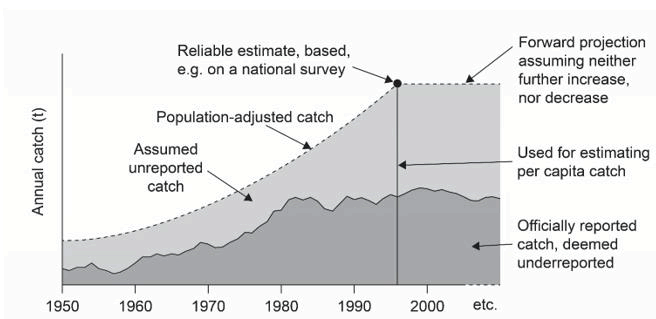
Figure 1. Schematic element of the one-point+population approach, which relies primarily upon a single catch estimate derived independently of FAO data (and for a year not earlier than 1990) of the total inland fisheries catch of a country or territory and which is assumed to be more reliable than the catch reported to and by the FAO for the same year. The backward projection of predicted annual catches assumes that earlier per capita consumption is the same as that of the year for which the independent point estimate of catch was determined. However, the human population was lower (this assumption, as with the following, can be easily modified given reliable supplementary information). The flatlining of catch estimates is assumed to be the safest approach for implementing forward projection, given the absence of supplementary information on current catch trends, which may be increasing or decreasing.
Further details regarding this proposed procedure for correcting reported catches, including its various modifications developed to accommodate special conditions and their applications to the freshwater fisheries of African countries and territories, are presented below. Note that this proposed catch correction procedure does not distinguish between fishery sectors-i.e., industrial (e.g., the kapenta fisheries of Lake Kariba, Zambia/Zimbabwe), artisanal (i.e., small-scale commercial), subsistence and recreational fisheries–unlike earlier catch reconstructions (Pauly and Zeller 2016a, 2016b).
The ‘one-point+population’ approach summarized in Figure 1 is here elaborated upon, in addition to its several variants, which were developed for application to the inland fisheries of African countries and territories.
One-point+population approach
The ‘one-point+population’ approach was the approach most frequently employed in our analyses, particularly for countries and territories for which detailed inland fisheries information was lacking, but a reliable, preferably peer-reviewed and always FAO-independent point estimate of the overall inland fisheries catch for the country or territory was available for any year following 1989. One example of such survey-based studies is Fluet-Chouinard, et al., 2018.
To apply this approach, when one reliable and independent (i.e., not FAO-derived) point estimate was available for the freshwater fisheries catch or freshwater fish consumption for a year not previous to 1990, this estimate was re-expressed as an estimate of annual freshwater fish consumption per capita (for the year for which the relevant survey was performed) by dividing the independent catch estimate by the estimate of human population of the particular country or territory for the same year. Then, a tentative freshwater fisheries catch estimate was generated for each year preceding the independent catch estimate by multiplying the estimated value of annual per capita freshwater fish consumption by population estimates for each year extending back to 1950. This process assumes, in the absence of conflicting data, a constant estimate of annual freshwater fish consumption per capita for catch analyses based on each discrete independent catch estimate. The national population estimates since the year 1950 were primarily obtained from the World Bank Group (2021).
Also, the value of the independent point estimate of inland fisheries catch is projected forward (i.e., flatlined) to the near-present, assuming, in the absence of any additional information, that the freshwater fisheries catch remained self-similar over time in the years following that for which the survey was conducted. Assuming otherwise (i.e., that inland fisheries catch has either increased or decreased through time after a particular survey is conducted) requires evidence, which, for the inland fisheries of the countries and territories assessed using this approach, is precisely the information that is not available. In the absence of robust and reliable national freshwater fisheries catch statistics, developed after having collected and analyzed comprehensive catch estimates for each inland water body in which fisheries operate across an entire country or territory, this flatlining approach is practical in offering a reasonable long-term average for a broad range of potential catch development scenarios.
Thus, while the reconstructed freshwater fisheries catch time series derived from the one-point+population approach (schematically illustrated in Figure 1) are tentative, they are indeed compatible with the best-available independent point estimates of the inland fisheries catch for each respective country and territory, with reasonable projection backward and forward in time. This approach can easily accommodate changes, should more recent survey data (or other useful data) become available. In such cases, provisional catch profiles generated through the use of this approach will be updated in the database and website of the Sea Around Us (www.seaaroundus.org), where these inland fisheries catch profiles will be presented.
Multi-point+population approach
For countries and territories for which multiple, varying and independent point estimates were available, the estimates that appeared most trustworthy (e.g., those covering the entire time period with adequate taxonomic resolution) were used. For instances in which numerous different estimates appeared equally reliable, the lowest and most frequently reported estimate was selected, as this present study aims to correct freshwater fisheries under-reported catch data while still providing conservative estimates.
FAO catch+population approach
For cases in which a thorough review of relevant literature yielded catch estimates derived independently of FAO-reported data which substantiated the inland fisheries catch data published by the FAO for recent years, but where FAO-reported catches were lacking (or exceedingly low) during earlier years, the human population growth of a given country from 1950 to an ‘anchor’ year with a high FAO-reported catch value was used to model the increase of the freshwater fisheries catch in that country. Depending on the perceived reliability of the FAO-reported catch data in later years (assessed using the details of their taxonomic resolution as a key criterion), the high catch value for the anchor year was either flatlined forward (for subsequent catches deemed unrealistic or unreliable) or left to follow the FAO-reported catch trends (for subsequent catches deemed realistic or reliable).
Comprehensive catch reconstruction approach
If there exists an abundance of reliable and independent inland fisheries catch data available for a particular country or territory, its inland fisheries catch can be reconstructed following the methodology described by Zeller, et al., (2015). As this reconstruction approach could only be applied to Burundi and Kenya in this study, we hereby abstain from a detailed description of this approach, which may also be found in Pauly and Zeller (2016b), in addition to the fisheries catch reconstructions of each country presented at www.seaaroundus.org.
Assessment of reliability
The long-overlooked dearth of accessible, credible data for African freshwater fisheries poses a serious impediment to any assessment of their reliability (in terms of both precision and accuracy) and further presents extreme challenges in analyses of these data; thus, three separate approaches are here employed to achieve a tentative evaluation of data quality.
The first approach here used to assess data quality is a methodology modified for fisheries catch reconstruction adapted by Zeller, et al., (2015) and derived from an approach which was initially developed to facilitate the evaluation of the reliability of data used in assessments conducted by the Intergovernmental Panel on Climate Change (IPCC), proposed by Mastrandrea, et al. (2010) and summarized in Table 1.
| Score | ± (%) | Corresponding IPCC criteriaa) | |
| 4 | Very high | 10 | High agreement and robust evidence |
| 3 | High | 20 | High agreement and medium evidence or medium agreement and robust evidence |
| 2 | Low | 30 | High agreement and limited evidence or medium agreement and medium evidence or low agreement and robust evidence |
| 1 | Very low | 50 | Low agreement and low evidence |
| Note: a) Mastrandrea et al. (2010) note that “confidence increases” (and hence confidence intervals are reduced) “when there are multiple, consistent independent lines of high-quality evidence.” | |||
Table 1. Scores for evaluating the quality of time series data for reconstructed fisheries catches, with their approximate confidence intervals (IPCC criteria are from Figure 1 of Mastrandrea et al. 2010); the percentage intervals, here applied from Pauly and Zeller (2016b) which is updated from Zeller, et al. (2015) are adapted from Ainsworth and Pitcher (2005) and Tesfamichael and Pitcher (2007).
Here again, the evaluation of the ‘reliability’ of freshwater fisheries catch statistics was informed by the details of the taxonomic resolution of the catch data and their consistency throughout time, which, however, was inapplicable to the magnitude of countries’ catches.
A second approach used to assess the reliability of data is a comparison of the total African inland fisheries catch estimated in this study with previously reported independent catch estimates for the continent as a whole.
The third approach to evaluating data quality is to compare, for each African country and territory with a coastline and thus an Exclusive Economic Zone (EEZ), the ratio of their reconstructed marine fisheries catch to that officially reported to the FAO. As many African countries gained independence only in the 1960s and could claim their respective EEZs only once the UNCLOS treaties were codified and enshrined under international maritime law in 1983, these particular comparisons were performed only for the 30 years spanning 1990 to 2019.
The rationale structuring this third approach relies on the presumption that, in principle, it should be less difficult for a country to monitor its national fisheries (which, in Africa, typically operate predominantly within its respective EEZ) which land their catches along a coastline (Figure 2B) than for the same country to monitor the landings of its inland fisheries, which are scattered across the surface of the country (Figure 2A).
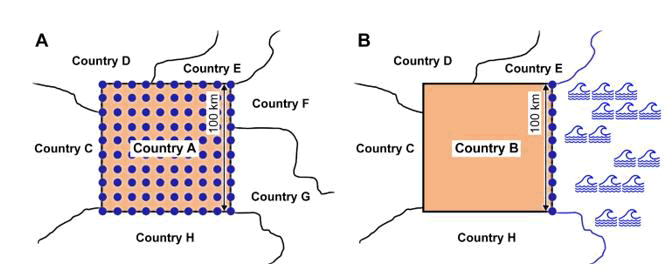
Figure 2. Contrasting the inland and marine fisheries monitoring systems (i.e., blue dots, representing, e.g., personnel) of small hypothetical African countries (one landlocked and the other coastal) to demonstrate the impact of dimensionality on fisheries operations. A) Schematic representation of the inland fisheries monitoring system of a landlocked country; i.e., Country A, surrounded by countries C to H. Inland fisheries have the potential to operate all across the country's surface and are thus represented as 10 × 10 dots evenly distributed 10 km apart across the entire 10,000 km2 surface area. B) Schematic representation of the marine fisheries monitoring system of a coastal country; i.e., Country B, surrounded by countries C, D, E and H, with countries F and G replaced by a coastline. Marine fisheries landings need to be monitored only along a one-dimensional coastline, which, in this example, requires 10 times less personnel to achieve the same degree of monitoring intensity as for Country A.
Of the numerous islands and archipelagos surrounding the African continent which are either independent (e.g., Cabo Verde, Mauritius and Seychelles) or territories of other countries (e.g., Canary Islands and Comoros) all excepting Madagascar, Mauritius and Reunion have either no or negligible inland (or freshwater) fisheries and are thus not considered here again, excepting Madagascar, Mauritius and Réunion.
Therefore, in addition to the islands of the three previously specified countries and territories, this study considers only countries on the African continent proper, excluding the Spanish enclaves of Ceuta and Melilla located along the coast of northern Morocco (to which the ex-Spanish Sahara is here allocated). Of these countries considered in this study, only two (i.e., Djibouti and Libya) bear negligible or no inland fisheries. Accordingly, graphs of inland fisheries catch reconstructions similar to those exhibited in the four panels of Figure 3 are available for the 49 geographic entities addressed here in this study in Smith (2023) and also at www.seaaroundus.org, along with their respective reliability scores and other details not presented here. Note also that in the future, the taxonomically undifferentiated ‘official’ catches will be gradually disaggregated and national catch profiles appropriately updated based on the FAO-reported fisheries statistics and other information.
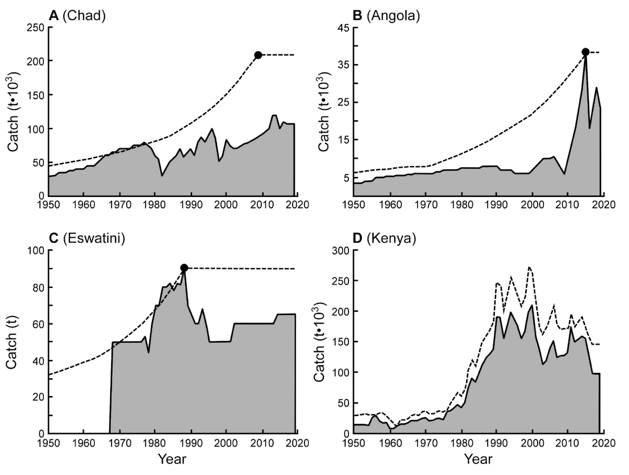
Figure 3. Four representative examples of the tentative catch reconstructions developed in this study, with A) Chad (reliability score=3) illustrating the ‘one-point+population’ approach; B) Angola (reliability score=3) and C) Eswatini (reliability score=2) illustrating the ‘FAO catch+population’ approach; and D) Kenya (reliability score=4) illustrating the comprehensive catch reconstruction performed by Schubert et al. (2022).
Figure 4 presents the inland fisheries catch trends for the entire continent of Africa suggested by reconstructions generated in this study. This is compared with other estimates of total African freshwater fisheries catch, derived from the fisheries statistics reported by the FAO, as well as two studies, particularly that of Muringai et al. (2022), which have interpreted these data in a manner that approaches our estimate.
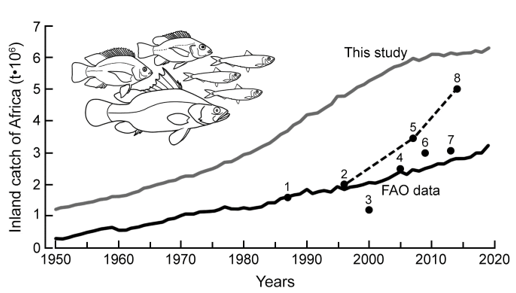
Figure 4. Sums of the reconstructed inland fisheries catch estimates for the entirety of the African continent, which are described in this contribution, compared to those that are reported to the FAO by its African member countries.
Note: The point estimates of freshwater fisheries catch are also largely based on the catch data reported by the FAO and their authors are: (1) Vanden Bossche and Bernacsek (1990); (2) Geheb and Sarch (2002); (3) Crisman, et al. (2003); (4) Welcomme (2011); (5) Ainsworth, et al. (2023); (6) Bartley, et al. (2015); (7) FAO, Duke University and WorldFish (2023); and (8) Muringai, et al. (2022). The eight black dots, which represent these point estimates, were shifted three years back before their respective publication dates to account for the 1-2 years during which the FAO-reported catch statistics lag behind actual fisheries catches, in addition to the approximate time required to design, perform and publish a study. The dashed black line suggests that some researchers, particularly Muringai, et al., (2022), are correcting the FAO-reported catch data such that their estimates of the total inland fisheries catch for Africa resemble those generated in this contribution.
Finally, Figure 5 presents a comparison between the degree of catch underreporting determined for the marine fisheries of 32 of Africa’s maritime countries (as documented by contributions in Pauly and Zeller 2016 b) with that determined for the inland fisheries of the same 32 countries and territories.
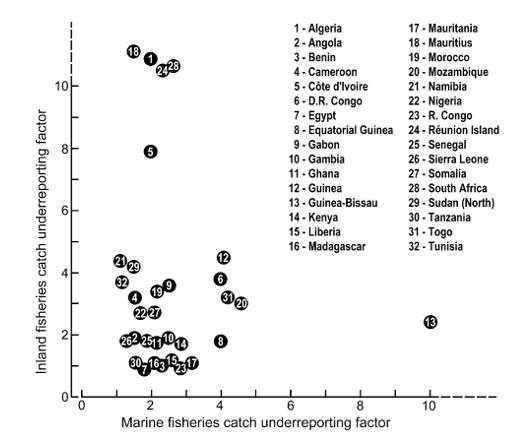
Figure 5. Average underreporting factors determined in this study for the catches of the marine and inland fisheries of the 32 maritime African countries with both marine and freshwater fisheries operations. Note that the underreporting factors were calculated for national inland fisheries catches for the years 1950 to 2019, while the corresponding underreporting factors for marine fisheries were obtained from Pauly and Zeller (2016a) and www.seaaroundus.org for the same time period.
The comparison of fisheries catch underreporting factors presented in Figure 5 suggests that, generally, marine fisheries catches are better documented by Africa’s 32 maritime countries with both marine and inland fisheries than are their freshwater fisheries catches, possibly for the reason illustrated in Figure 2.
As shown above, the officially reported catches of inland fisheries are underreported by most countries and territories (Fluet-Chouinard, et al. 2018; Smith 2023), as are marine fisheries catches worldwide, which have been underreported by the FAO by up to 50%.
However, the direct comparison of underreporting for inland and marine fisheries, which tend to be mostly similar in Figure 5 is biased, because about 50% of the catch of marine fisheries along African coastlines is taken by the distant water fleets of European or Asian countries, which may be reported by Regional Fisheries Management Organizations (RFMO) or to FAO, but by large statistical areas not taking account of countries’ EEZ. This suggests that the catch of inland fisheries is, in Africa, more strongly underreported than the catches of marine fisheries, possibly for the reason presented in Figure 2.
The fundamental argument presented here in this contribution is not straightforward to make convincingly or to accept prima facie: How is one supposed to accept that a single data point (i.e., a single estimate of fisheries catches) can invalidate decades of fisheries data collected (and subsequent statistics developed) at considerable expense by sometimes hundreds of field and laboratory personnel?
The response to this question is two-fold:
• The single data points selected for this analysis approach were derived from independent data analyzed through independent studies of fisheries (or related research), which are generally considered to be more accurate than government-reported fisheries statistics. This is why most of these independent studies were or could be published in peer -reviewed scientific journals.
• The use of the method presented here does not even contradict, let alone negate, the value of officially reported fisheries catches estimates. Instead, use of this analysis method complements these official catch statistics by providing a reasonable approximation of the proportion of inland fisheries catches which could have been overlooked due to any combination of factors, including (i) Budgeting of resources to deal with other, more-immediate governmental priorities (e.g., occasional reduction in or complete lack of, funding to support the dispatch of adequate field personnel); (ii) Security concerns (e.g., regions which are inaccessible owing to civil strife or environmental threats to safety); (iii) Faulty statistical extrapolations drawn from regional samples and applied to an entire country or territory; and (iv) Assorted other like challenges which tend to complicate and impede the consistent and accurate collection, analysis and interpretation of fisheries data (Jerven, 2013).
One might also object to the assumption underlying this analysis approach, which assumes a constant rate of per capita freshwater fish consumption (determined for the year for which a relevant and reliable independent estimate of inland fisheries catch was available) multiplied by annual national population estimates from earlier decades. However, the use of national population growth rates in combination with per capita production (or consumption) rates of various terrestrial crops is standard practice for deriving official agricultural statistics for the countries and territories of (sub-Saharan) Africa, despite the validity of all elements which comprise this estimation procedure including the human population estimates themselves being contested by some researchers (Jerven, 2013).
Ultimately, through use of the methodology presented in Figure 1 (and further elaborated upon throughout this contribution) and given the existence of at least one reliable independent estimate of the national catch (or per capita consumption) of freshwater fish for any (somewhat) recent year, it is certainly possible to overcome the first challenge in addressing the oft-heard complaint that “there are just no data!”
We thank Dr. Jos Snoeks (University of Leuven, Belgium) for several invaluable insights regarding the countries that comprise Central Africa.
[Crossref] [Google Scholar] [PubMed]
[Crossref] [Google Scholar] [PubMed]
[Crossref] [Google Scholar] [PubMed]
[Crossref] [Google Scholar] [PubMed]
Select your language of interest to view the total content in your interested language