 ...the monthly, Open Access Publisher.
...the monthly, Open Access Publisher.
...the monthly, Open Access Publisher.

Research Article - (2025) Volume 13, Issue 1
Received: 25-Oct-2024, Manuscript No. AJSS-25-150963; Editor assigned: 28-Nov-2024, Pre QC No. AJSS-25-150963 (PQ); Reviewed: 12-Dec-2024, QC No. AJSS-25-150963; Revised: 26-Dec-2025, Manuscript No. AJSS-25-150963 (R); Published: 03-Jan-2025
Understanding the long-term effect of temperature increases on soil respiration remains difficult to date. To the best of our knowledge, there is a paucity of literature on how soil respiration responds to long-term temperature increases in field experimental studies. A 17-year field study was conducted in a tallgrass prairie in Oklahoma, USA, to assess how soil respiration would respond to temperature rises in long-term warming and to investigate the underlying mechanisms regulating soil respiration in this ecosystem. Moreover, to mimic the traditional method of collecting hay in this region, a further step known as the clipping treatment was put into place. We measured soil respiration rates, Net Primary Production (NPP), and environmental variables, including air and soil temperature and soil moisture. Our results showed that warming significantly enhanced soil respiration in both clipped and unclipped plots. Soil respiration was primarily controlled by temperature. Under all treatments, the responses of soil respiration to temperature were nonlinear, increasing with temperature first until reaching the optimum temperature and then declining at high temperatures. Furthermore, it was found that warming-induced changes in soil respiration were significantly and positively correlated with changes in Aboveground NPP (ANPP) due to warming, which was dominated by the changes in ANPP of C3 species rather than C4 species. Belowground NPP (BNPP) and soil moisture did not have a significant effect on soil respiration. Our findings suggest that the ongoing climate change will keep stimulating soil respiration in tallgrass prairie ecosystems, which would exacerbate climate change, and this needs to be further investigated on a broader spatial scale.
Clipping, Net primary production, Soil respiration, Tallgrass prairie, Warming
Soil respiration is one of the main processes by which Carbon dioxide (CO2) fixed by plants on land is released back into the atmosphere (Gougoulias et al., 2014). Furthermore, soils are the largest reservoir of organic Carbon (C) in terrestrial ecosystems, containing more C than plant biomass and the atmosphere combined. In addition, soil C pool and flux are subject to disturbances by human activities (Canadell et al., 2010), resulting in the significant release of greenhouse gases such as CO2. Greenhouse gases are the primary cause of global warming, and the prediction indicated a global temperature increase of 1.4 to 5.8°C between 1990 and 2100. Variation in soil respiration is dominantly controlled by temperature, and warming rapidly accelerates the decomposition of soil organic matter, resulting in an increase in soil respiration (Carey et al., 2016). For example, several studies have shown global warming influences soil respiration, and temperature increases stimulate soil respiration (Luo et al., 2001; Bond-Lamberty and Thomson, 2010). However, to the best of our knowledge, knowledge about how soil respiration responds to temperature rise in the long term is still scarce, as few field studies have been carried out for more than 10 years to explore the effect of long-term warming on soil respiration. It has been found that not only temperature and soil moisture but also plant production can regulate soil respiration because the decomposed organic matter by soil respiration is the primary input of plant C into the soil (Kotroczó et al., 2023). An increase in temperature could generate stress on plant growth and reproductive processes for some plants (Engel et al., 2009; Hatfield and Prueger, 2015), imposing an indirect effect on soil respiration through reduced substrate. However, increased decomposition of dead plants due to heat stress could lead to an increase in soil respiration rate (Flanagan et al., 2013; González and Seastedt, 2001). In addition, it was found that temperature increases favor C4 grasses over C3 plants. Therefore, it is very crucial to investigate how plant production and its components, i.e., C3 or C4 plant production, regulate soil respiration under warming.
In this research, we analyzed the soil respiration rates from a long-term field warming experiment from 2000 to 2017 in a tallgrass prairie in the central USA, and the main objectives were to understand how soil respiration responds to warming and the regulatory factors of soil respiration. We asked the following questions:
Our findings would be useful to understand the long-term responses of soil respiration in grassland ecosystems to climate change, given that most studies were conducted in relatively short periods of time.
Study site
The study was carried out in a tallgrass prairie ecosystem located at Kessler Atmospheric and Ecological Field Station (KAEFS) in Oklahoma, USA (34° 58′ 31.8″ N, 97° 31′ 19.6″ W). The site was neither cultivated nor grazed for over 40 years before starting the experiment in November of 1999. The mean annual temperature was 16.0°C, and the mean annual precipitation was 967.2 mm, according to the Oklahoma climatological survey. The minimum and maximum temperatures recorded were -23.8°C and 44.4°C, respectively. The soil type was silt loam, which belongs to the Nash-Lucien complex soil with a high available water content of 37%, a moderately penetrable root zone, and a pH around 7. The most dominant species were C4 species (Schizachyrium scoparium and Sorghastrum nutans) compared to C3 plant species (Ambrosia psilostachya, Solidago nemoralis and Solidago rigida) (Xu et al., 2015).
Experimental manipulation
In our experiment, we used a paired, nested design with warming as the main factor and clipping as the secondary factor. The experiment had six replicates (i.e., six pairs of plots, Figure 1a), with each pair consisting of a warming plot and a control plot, totaling 12 plots of 2 m × 2 m each. Within a pair of the two plots, one plot was warmed continuously since November 21, 1999, by using a Kalglo Electric Radiant Infrared Heater with a radiation output of 100 W/m2 , which was hung at 1.5 m above the center of each plot to elevate the temperature by about 1.5°C, while another plot was kept at ambient temperature as control (Figure 1b). In the control plots, dummy heaters were suspended at the same height as the infrared heaters in the warmed plots to generate similar shading effects from the heaters. A 5-m distance between the warmed and control plots was maintained to avoid heating the control plots, and the distances between the two adjacent pairs varied from 20 to 60 m.
Each plot contained four equal-sized subplots that were 1 m × 1 m each, as shown in Figure 1c. Two diagonal subplots within each plot had their plants clipped annually at the peak biomass period, at a height of 10 cm above the ground to mimic the local land use practice of harvesting hay. The remaining two subplots were left unaffected. Clipped biomass was removed from the plots permanently.
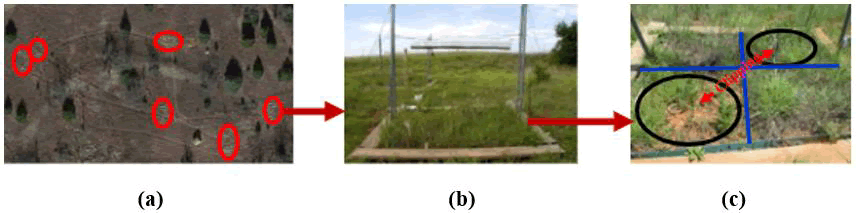
Figure 1. Location of the six pairs of plots (a), the size of each plot (b), and the segmentation in each plot (c).
Measurements
Soil respiration measurements: Before the experiment started, PVC collars with a height of 5 cm and a diameter of 10.16 cm were installed to a depth of 2-3 cm, located at the center of the two 1 m × 1 m subplots (one was clipped and the other was unclipped) in each of the 2 m × 2 m plots. Soil respiration rates were measured using LI-COR 8100 (LI-COR, Lincoln, NE, USA) between 10:00 and 15:00 every month or twice a month. Measurements made within a month were averaged to be presented as yearly data.
Plant production measurements: Net Primary Production (NPP) of plants comprising Above-Ground (ANPP) and Below-Ground (BNPP) net primary production was estimated annually. ANPP was estimated using the clipped biomass for mimicking hay harvesting in the clipped plot as abovementioned. Above-ground plant biomass, separated into C3 and C4 plants, was harvested and dried at 65°C for 72 hours to estimate ANPP in the clipped plots, whereas in unclipped plots, above-ground plant biomass, i.e., ANPP, was indirectly estimated by a pin-contact method. To determine BNPP, root ingrowth cores of 4.05 cm in diameter were installed into soils at 45 cm depth in two subplots (one clipped and another unclipped) in each plot in 2005. Each year at peak root biomass season, soil samples in the ingrowth cores were taken back to the laboratory for separating, drying (70°C for 48 h), and weighing the roots to estimate BNPP. For each ingrowth core, soil samples and thus root samples were taken at depths of 0-15 cm, 15-30 cm, and 30-45 cm, respectively, and the sum of root biomass at all three depths was used to estimate total BNPP. It should be noted that data in 2011 was missing.
Measurements of air and soil temperature and soil moisture: Shielded thermocouples were placed at the center of each control and warming plot, 25 cm above the ground, to record air temperature automatically. In each plot, soil temperature was automatically measured by thermocouples at a depth of 2.5 cm in the center of each clipped and unclipped subplot. Soil moisture was determined using a portable Time Romain Reflectometry (TDR) at a depth of 15 cm, along with measurements of soil respiration rates. Similar to soil respiration data, temperature and soil moisture data measured within a month were averaged to represent yearly data.
Statistical analysis
The differences in soil respiration rates, air and soil temperature, and soil moisture between treatments (i.e., warming versus control) in clipped and unclipped plots were examined using Analysis of Variance (ANOVA) with the SPSS software (version 26, IBM SPSS Statistics). Regression analyses were performed to examine the relationship between soil respiration rates and plant production (including ANPP and BNPP), air and soil temperature, or soil moisture, using Origin Pro (version 2023, Origin Lab Corporation, Northampton, MA, USA). Statistically significant differences or correlations were deemed when a p value was less than 0.05. Graphs were also plotted using Origin Pro.
The effect of warming on soil respiration
There were variations in soil moisture, soil temperature, and soil respiration rates in all treatments from 2000 to 2017 (Figure 2). By comparing the effects of warming, warmed plots showed significantly higher soil temperature and soil respiration rates than control plots for both clipped and unclipped treatments. However, while warming slightly decreased soil moisture in both clipped and unclipped treatments, no significant difference in soil moisture was observed between the control and warmed plots under either clipped or unclipped treatment.
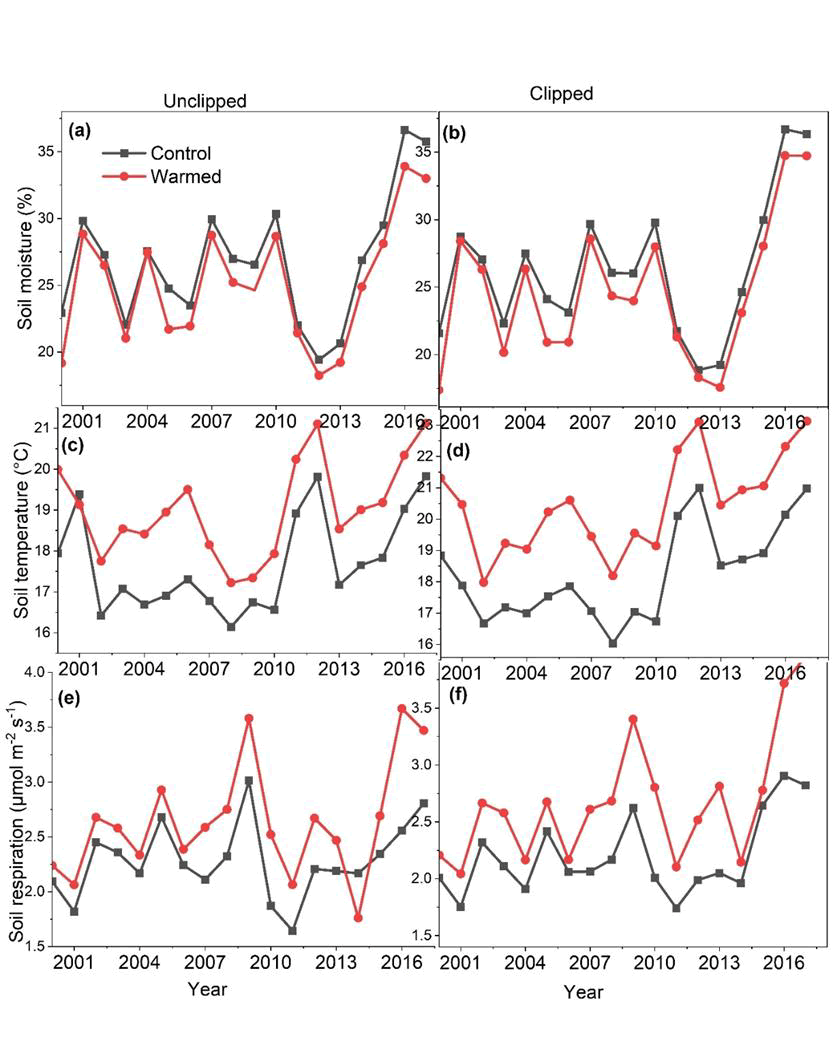
Figure 2. Yearly volumetric soil moisture (a, b), soil temperature (c, d), and soil respiration rates (e, f) measured from a long term warming experiment from 2000 to 2017. The left and right columns indicate unclipped and clipped treatments, respectively.
Correlation between soil respiration and temperature or soil moisture
Correlation between soil respiration and air temperature: Our results showed that soil respiration was significantly correlated with air temperature in both control and warmed plots, with R2 values of 0.74 and 0.73, respectively, and P<0.01 for both treatments (Figure 3).
The warmed plots showed an increase in soil respiration as the air temperature increased from -2.73°C to 29.52°C.
The soil respiration rate was 0.28 µmol m-2 s-1 at -2.73°C and reached a peak of 4.87 µmol m-2 s-1 at 29.52°C. However, as the air temperature continued to increase to 37.5°C, soil respiration declined to a value of 2.54 µmol m-2 s-1 . In the control plots, we observed that as air temperature increased from -3.18°C to 27.74°C, soil respiration also increased from 0.34 µmol m-2 s-1 to a peak value of 4.54 µmol m-2 s-1 , and then decreased to 2.43 µmol m-2 s-1 when air temperature reached 34.32°C.
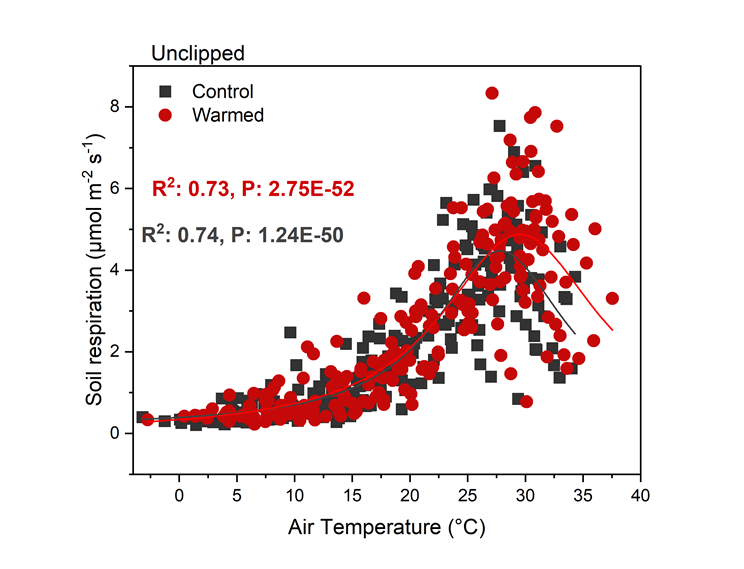
Figure 3. The relationship between soil respiration and air temperature. Red and grey colors represent warmed and controlled plots, respectively. The solid red and grey lines show nonlinear regression fit lines in the warmed and control plots, respectively.
Correlation between soil respiration and soil temperature or soil moisture: The correlation between soil respiration and soil temperature was similar to that between soil respiration and air temperature. Specifically, soil respiration was significantly corelated with soil temperature, with R2 between 0.71-0.79 and p values<0.01, including all four treatments (Figure 4a,b). Furthermore, soil respiration increased with soil temperature until the optimal soil temperature, and then it started to decrease when soil temperature was very high under all treatments. In the unclipped, warmed plots, increased soil temperature elevated soil respiration rates from 0.41 µmol m-2 s-1 at a soil temperature of 3.87°C to the highest soil respiration rate of 5.14 µmol m-2 s -1 at the optimum soil temperature of 28.44°C. After that temperature, we observed a decline in soil respiration rates to 2.42 µmol m-2 s-1 at the highest soil temperature of 36.06°C. In unclipped control plots, the lowest soil respiration rate was 0.31 µmolm-2 s-1 when soil temperature was 1.45°C. It increased to 4.57 µmol m-2 s-1 at the optimum soil temperature of 27°C and then declined to 1.92 µmol m-2 s-1 at 35.7°C.
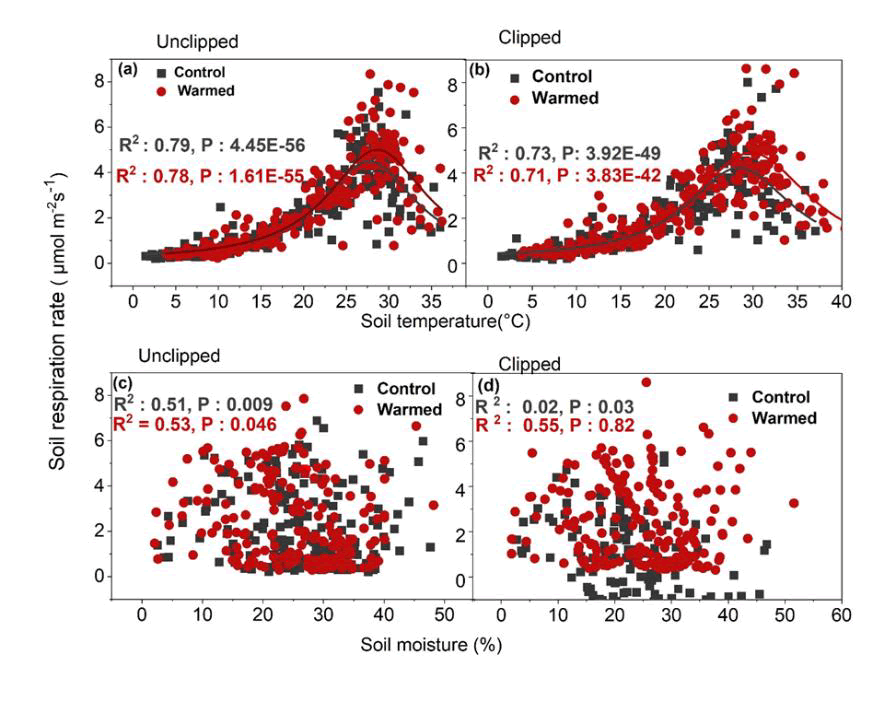
Figure 4. Correlations between soil respiration and soil temperature or soil moisture in control and warmed plots. The left and right columns represent unclipped and clipped plots, respectively. Red and grey colors represent warmed and controlled plots, respectively. The solid red and grey lines show nonlinear regression fit lines in the warmed and control plots, respectively.
The optimum soil temperature for soil respiration in the clipped treatment was a little higher than that in the unclipped treatment. For example, the lowest soil respiration rate in clipped, warmed plots was 0.35 µmol m-2 s-1 at a soil temperature of 3.82°C. The optimum soil temperature in this treatment was 29.89°C when soil respiration peaked at 5.11 µmol m-2 s-1 .
When soil temperature further increased to 39.43°C, soil respiration rate dropped to 2.05 µmol m-2 s-1 . For the clipped, control plots, the lowest (0.31 µmol m-2 s-1 ) and highest (4.10 µmol m-2 s-1 ) soil respiration rates occurred at soil temperatures of 1.53°C and 28.80°C, respectively. At the highest soil temperature of 36.75°C, soil respiration rate declined to 1.91 µmol m-2 s-1 .
For the results of soil moisture, there was no significant correlation between soil moisture and soil respiration (Figure 4c,d).
Regulations of soil respiration by NPP
Regulations of soil respiration by above and below-ground NPP: Changes in soil respiration induced by warming, i.e., soil respiration rates in warmed plots minus soil respiration rates in control plots, showed a significant correlation with warming-induced changes in ANPP, i.e., ANPP in warmed plots minus ANPP in control plots (Figure 5), with a higher R2 in the unclipped treatment (0.46) than in the clipped treatment (0.23). However, such correlations were not found for BNPP.
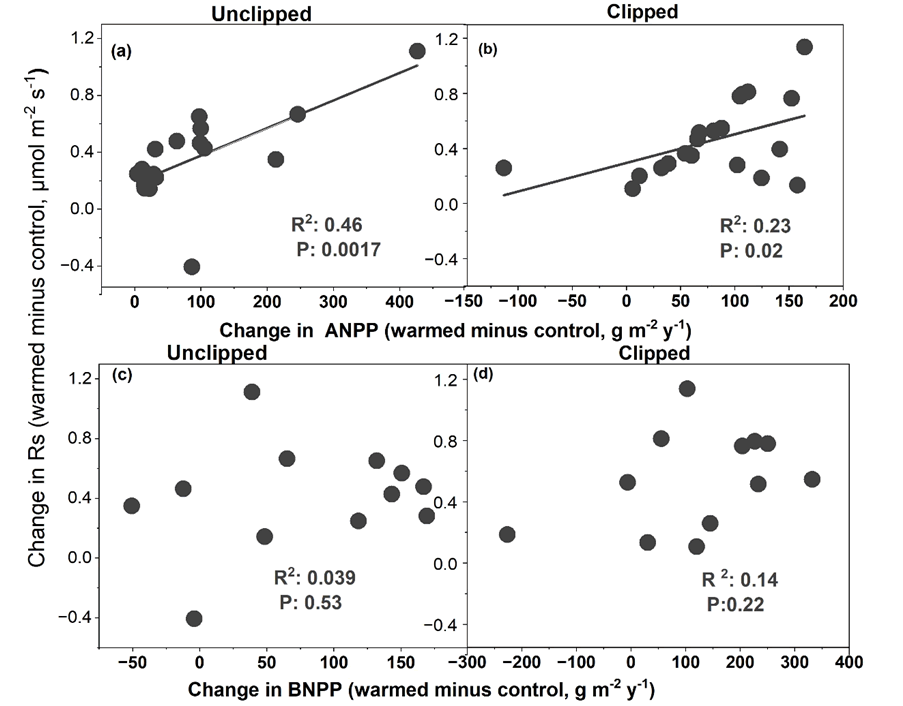
Figure 5. Correlations between changes in soil respiration and changes in above-ground net primary production (ANPP, (a, b) and below-ground net primary production (BNPP, (c, d) due to warming in unclipped and clipped plots.
Regulations of soil respiration by ANPP of C3 and C4 plants: The evaluations on the contributions of C3 and C4 plants to warming-induced changes in soil respiration showed that the warming-induced changes in ANPP of C3 plants had a positive effect on the warming-induced changes in soil respiration rates in both clipped and unclipped plots (Figure 6). In contrast, warming-induced changes in ANPP of C4 plants had no significant correlation with warming-induced changes in soil respiration rates.
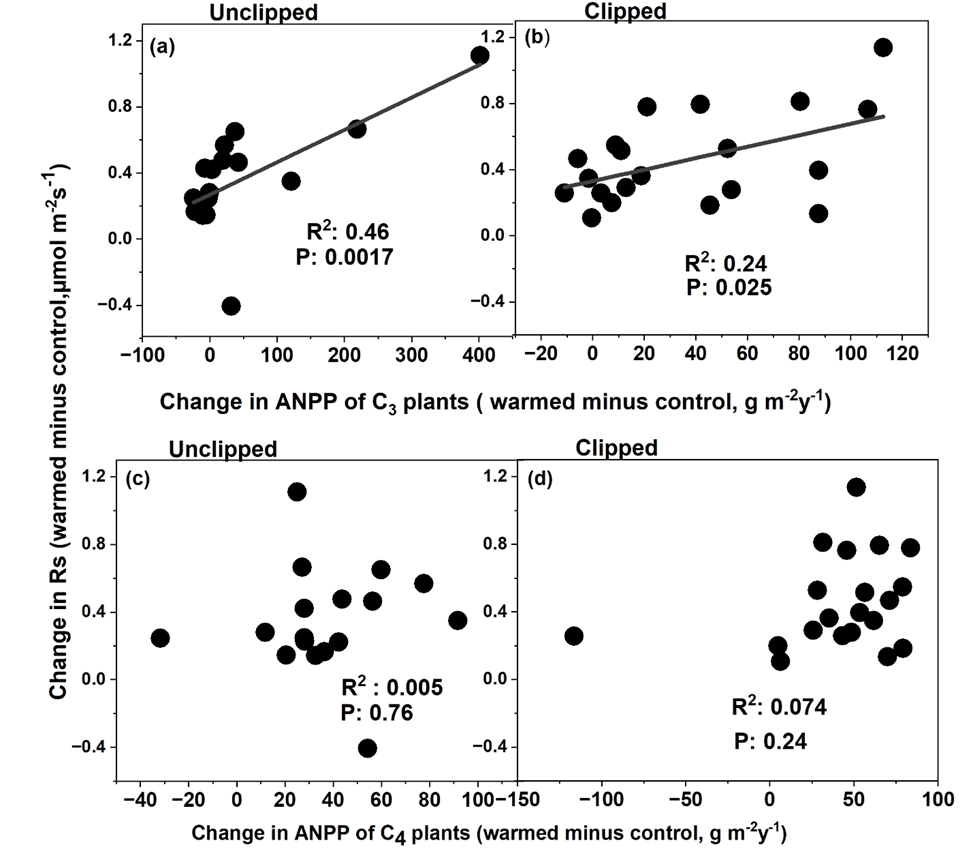
Figure 6. Correlations between changes in soil respiration and changes in Above-Ground Net Primary Production (ANPP) of C3 (a, b) and C4 plants (c, d) due to warming in unclipped and clipped plots.
Increased soil respiration under long-term warming
In our study, we demonstrated that long-term warming kept stimulating soil respiration in the tallgrass prairie ecosystems, suggesting that ongoing climate change generates natural warming, which would stimulate soil respiration due to an increase in Earth’s temperature (Bond-Lamberty and Thomson, 2010). As shown in Figure 2, warming induced a decrease in soil moisture while increasing both soil temperature and soil respiration. Additionally, soil temperature continued to increase over the years.
According to the Intergovernmental Panel on Climate Change report on global warming of 1.5°C, they predict that future warming will exceed earlier estimates. The rise in greenhouse gas emissions is a response to increasing temperature, and it has been found that soil respiration is temperature-sensitive under current climate circumstances. Our results showed evidence that climate warming results in increased soil respiration, which has a positive feedback effect on global warming.
Dependence of soil respiration on temperature
Our findings based on a long-term warming experiment indicated that the variations in soil respiration rates over time for both control and warmed plots were largely due to changes in temperature. Soil respiration was significantly and strongly correlated to air and soil temperature, as shown in Figures 2 and 3, in which R2 varied from 0.71 to 0.79. Our results are supported by several previous studies. For example, Li et al. (2008) and Xiao et al. have documented that soil respiration is predominantly controlled by soil temperature on certain days of the year. Jian et al. (2022) used global-scale data and reported that monthly air and soil temperatures were significantly correlated with soil respiration.
However, it should be noted that the dependence of soil respiration on temperature in this study was not linear, meaning that soil respiration increased up to the optimum temperature and then declined when temperature exceeded the optimum temperature. Our results are consistent with the previous studies by Luo et al. (2001) and Wan and Luo, in which soil respiration increased with temperature but declined at extremely high temperatures. Furthermore, similar results were reported in an experiment that was conducted by Cable et al. (2011) in deserts.
They demonstrated that soil respiration increased with temperature increases up to 30°C and then declines. The observed relationship between soil respiration and temperature can be attributed to the activities of microorganisms in soil. Temperature regulates the activities of microorganisms, including the activities of fungal and bacterial microorganisms, which are the main groups producing CO2 during the decomposition of organic matter in soil. In response to temperature increases from winter to summer, the activities of soil microorganisms enhance and reach a peak when temperature increases to the optimum temperature, leading to the highest soil respiration (Christiansen et al., 2012). The observed decline of soil respiration at high temperatures results from the reduction of microbial activities. Compared to the dependence of soil respiration on temperature, the effects of soil moisture on soil respiration are diverse. In our study, soil moisture had no significant impact on soil respiration (Figure 4). This result was consistent with some previous studies that demonstrated that soil respiration had no relationship with soil moisture. For example, in a study on the effects of warming on soil respiration, Miao et al. (2020) also reported that soil moisture had no effect on soil respiration. Other studies, e.g., Lellei-Kovács et al., (2011) suggested that while soil moisture does have a noticeable effect on soil respiration, there might be other factors that have an even greater impact on this process. In contrast, some studies did find strong regulation of soil moisture on soil respiration. For instance, a study conducted by Hursh et al., (2017) found that soil moisture had a substantial influence on global soil respiration. Furthermore, another experiment conducted for 6 months in a humid tropical forest in Puerto Rico also demonstrated that there was a significant parabolic relationship between soil moisture and soil CO2 outflow with peak soil respiration.
Regulation of plant production on soil respiration
In this study, we found that plant production, i.e., ANPP, had a significant effect on soil respiration in both unclipped and clipped plots, as shown in Figure 4. Our further analysis indicated that it was the production of C3 plants rather than C4 plants that contributed to the changes in soil respiration under long-term warming (Figure 6). Our results of the positive correlation between soil respiration and ANPP are consistent with previous studies such as Yan et al., Chen et al. (2010), and Xu et al., which all reported that soil respiration rates correlated linearly and positively with ANPP. Therefore, our results and past studies both exhibit strong evidence that plant production and soil respiration are linked processes. This can be explained by the fact that plants produce organic matter, which is decomposed after plants die and becomes the food of organisms in soil. Moreover, increased soil respiration may stimulate ANPP because the nutrients contained in organic matter can be released and then absorbed by plants after organic matter being decomposed by microbes in soil. It is possible that warming may exacerbate future plant growth and production under extreme drought conditions because drought stress reduces plant growth by affecting physiological and biochemical functions (Hussain et al., 2018), resulting in reduced soil respiration. However, on the correlation of BNPP and soil respiration based on data from 2005 to 2017, both unclipped and clipped plots demonstrated a weak correlation between soil respiration and BNPP (p>0.05, Figure 5). Similar results were observed in a previous study, which found that the low root biomass made a small contribution to soil respiration.
A 17-year field experiment was conducted in a tallgrass prairie to explore how soil respiration responds to long-term warming and to evaluate the influence of plant production and environmental factors, i.e., air and soil temperature and soil moisture, on soil respiration. The results showed long-term warming significantly stimulated soil respiration in this ecosystem, regardless of clipping or not. In all treatments, soil respiration was largely regulated by air and soil temperature, but soil moisture alone had no significant effect on soil respiration. ANPP had a significant effect on soil respiration in both clipped and unclipped plots, mainly due to the contribution of C3 species, and we did not find a significant control of BNPP on soil respiration. Our findings demonstrate that climate warming will cause continuous soil C loss from tallgrass prairie ecosystems, which has positive feedback between climate change and soil respiration. These findings highlight the need for future research to incorporate the impacts of the cumulative loss of C from terrestrial ecosystems via soil respiration on climate change.
This work was financially supported by the US National Science Foundation Grant DEB 2242034.
[Crossref] [Google Scholar] [PubMed]
[Crossref] [Google Scholar] [PubMed]
[Crossref] [Google Scholar] [PubMed]
[Crossref] [Google Scholar] [PubMed]
[Crossref] [Google Scholar] [PubMed]
[Crossref] [Google Scholar] [PubMed]
[Crossref] [Google Scholar] [PubMed]
Select your language of interest to view the total content in your interested language